


Last Updated: November 10, 2026
Quick Summary
The fastest way to tell if a watch has sapphire crystal is to check the model's published specifications, since manufacturers that fit sapphire almost always state it. Look for SAPPHIRE markings on the caseback or dial, then confirm on the official product page. At-home tests like the water-drop test are clues, not proof.
- Clean the crystal first, then place one water drop on it; a rounded bead points toward sapphire.
- Breathe on the crystal and watch how fast the fog clears, but treat this as a weak signal.
- Never scratch a crystal to test it, since you risk permanent damage for a guess.
- A sapphire glass tester can be fooled by sapphire-coated mineral glass.
- Anti-reflective coatings and double domes can throw off the water-drop and tapping tests.
Table of Contents
- Start With the Spec Sheet, Not the Crystal
- How to Tell if a Watch Has Sapphire Crystal Without Removing It
- Sapphire vs. Mineral Crystal: What Actually Differs
- Is Sapphire Crystal Scratch Proof?
- What a Sapphire Glass Tester Can and Cannot Prove
- Coated Crystals, Double Domes, and Other Lookalikes
- Ranking the Tests by Confidence (and What to Avoid)
- Confirming Sapphire Crystal on The Sango 878 and The Pharaoh
- Frequently Asked Questions
Start With the Spec Sheet, Not the Crystal
Most people try to identify a watch crystal by looking at it. That is the hard way. The fastest way to tell if a watch has sapphire crystal is to check the model's published specifications first, because a manufacturer that fits sapphire almost always says so.
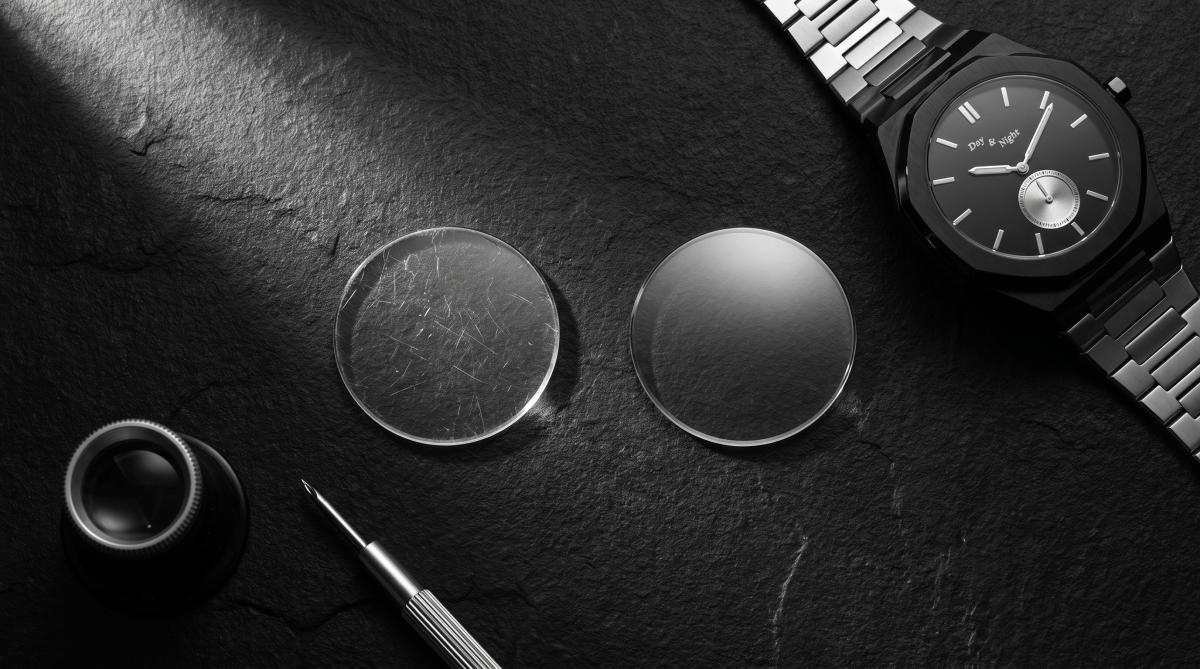
Crystal material is a key specification worth checking on any model page.
Here is where to look, in order:
- The caseback or dial text. Many watches print "SAPPHIRE" or "SAPPHIRE CRYSTAL" in small type near the 6 o'clock position.
- The model spec sheet. Search the reference number and open the official product page. Crystal type sits in the spec list, usually near the case material.
- The original box and papers. Warranty cards and hang tags often repeat the full specification.
- The listing where you bought it. A reputable seller states the crystal material plainly.
A common mistake is trusting a marketplace listing alone. Sellers copy specs from other listings, and errors spread. Confirm against the manufacturer's own page when you can.
If the spec sheet says mineral crystal, stop there. No test will turn it into sapphire.
How to Tell if a Watch Has Sapphire Crystal Without Removing It
When the paperwork is missing, you can still learn a lot without opening the case. The at-home methods below are clues, not proof. Treat them as a way to build confidence, not to reach a verdict.
Each test takes under a minute and needs no tools beyond water, your breath, and your ears.
The Water-Drop Test
The water-drop test is a surface-tension check. Sapphire is extremely smooth and non-porous, so a drop of water tends to sit up in a rounded bead rather than spread out. On mineral crystal, the drop often flattens and spreads wider.
How to run it:
- Clean the crystal with a soft cloth so oils do not skew the result.
- Place one small drop of water on the center of the crystal.
- Watch the shape for a few seconds.
- Tip the watch slightly and see how the drop moves.
A tight, rounded bead points toward sapphire. A flat, spreading puddle points toward mineral glass.
Watch out: this test is unreliable on a dirty or coated surface. Anti-reflective coatings and fingerprints both change how water behaves, so a spreading drop proves nothing on its own.
The Fog and Breath Test
The fog test uses condensation. Breathe on the crystal the way you would to fog a mirror, then watch how quickly the haze clears.
Sapphire conducts heat well, so the fog tends to vanish fast. Mineral crystal usually holds the haze a little longer. Some guides describe a similar result with a short blast of cold air.
This is a weak signal. Room temperature, humidity, and how hard you breathe all change the outcome. Use it to support other clues, never as a stand-alone answer.
The Sound and Touch Clues
Tapping a crystal with a fingernail produces a different note depending on the material. Watch writers describe a lower, solid sound as a sapphire clue and a higher, sharper pitch as a mineral-crystal clue. The touch test works on the same principle: sapphire often feels cooler at first contact because it moves heat away from your skin faster.
Both are party tricks, not proof. Case design, crystal thickness, and the dome shape all shift the sound.
Sapphire vs. Mineral Crystal: What Actually Differs
Sapphire crystal is a synthetic, lab-grown form of corundum, the same mineral family as ruby and sapphire gemstones. Mineral crystal is a hardened glass. Acrylic crystal, also called Hesalite or Plexiglas, is a soft plastic. That difference in material drives everything else: hardness, scratch resistance, and how the crystal handles a knock.
| Feature | Sapphire Crystal | Mineral Crystal | Acrylic Crystal |
|---|---|---|---|
| Material | Lab-grown corundum | Hardened glass | Soft plastic (PMMA) |
| Scratch resistance | Very high | Moderate | Low |
| Impact resistance | Good, but can chip | More forgiving | Very forgiving; dents rather than cracks |
| Clarity | High | Good | Good, but can yellow with age |
| Typical use | Premium watches | Budget and mid-range watches | Vintage and entry-level watches |
Hardness is the headline. Sapphire ranks near the top of the common hardness scales, which is why watchmakers use it on models meant to last decades. Mineral glass sits well below it and picks up fine scratches from daily wear. Acrylic is the softest and scratches easily, but those scratches can often be polished out with a mild abrasive.
The trade-off is impact. Sapphire resists scratches better, but a hard enough hit can chip or crack it. Mineral glass flexes more before it breaks, though it scuffs far more easily. Acrylic is the most impact-resistant; it may dent rather than shatter, which is why it appears on some military and vintage-style watches.
For a deeper side-by-side on wear, see our sapphire crystal vs mineral glass durability guide.
Is Sapphire Crystal Scratch Proof?
No. Sapphire crystal is highly scratch resistant, not scratch proof. Citizen notes that sapphire is very difficult to scratch, but difficult is not the same as impossible. Diamond, silicon carbide, and a hard knock against concrete or stone can still mark it.
That distinction matters if you work with your hands. A construction professional asking whether sapphire is tough enough for the job should hear the honest answer: it handles scrapes against wood, metal, and drywall far better than mineral glass, but a direct hit on a sharp edge can still chip the crystal.
Sapphire holds up well under light, everyday contact. Our guide on whether sapphire crystal is scratch proof for work covers impact behavior in more detail.
What a Sapphire Glass Tester Can and Cannot Prove
A sapphire glass tester is a small instrument, usually a pen-style device, that measures how readily heat moves through the crystal. Sapphire conducts heat differently than glass, so the reading separates the two.
What it can prove: whether the crystal is likely sapphire or likely mineral glass, in seconds, with more consistency than any at-home trick.
What it cannot prove: whether you are testing sapphire or a sapphire-coated mineral crystal. A thin sapphire layer on top of glass can fool a basic tester. Coatings, double domes, and layered crystals all complicate the reading.
Professional watchmakers use these tools alongside magnification and reference data. If a watch matters to you, a jeweler or watch repair shop can confirm the material quickly.
Coated Crystals, Double Domes, and Other Lookalikes
Not every clear crystal is plain sapphire, and not every sapphire is a single flat disc. Three variations trip people up.
Anti-reflective coating. A thin film on the crystal cuts glare and makes the dial easier to read. It also changes how water beads and how the surface feels, which can throw off the water-drop and touch tests.
Double-domed crystals. A domed crystal curves on both top and bottom. The shape changes reflections and sound, so a tapping test on a dome tells you less than on a flat crystal.
Sapphire-coated mineral glass. Some makers bond a thin sapphire layer onto mineral glass. It resists light scratches but is not a solid sapphire crystal.
Caring for coated surfaces takes a light touch. Our guide on how to maintain sapphire crystal watch glass covers safe cleaning and coating care without damaging the surface.
Ranking the Tests by Confidence (and What to Avoid)
Rank the methods by how much they actually tell you, and the order becomes obvious.
- Manufacturer spec sheet. Highest confidence. The maker states the material.
- Caseback or dial markings. High confidence when the watch is genuine.
- Professional sapphire glass tester. High confidence, with the coating caveat above.
- Water-drop test. Moderate clue. Useful, not definitive.
- Fog and breath test. Weak clue. Depends on conditions.
- Sound and touch tests. Weakest. Fun, but easy to misread.
What to avoid: never scratch the crystal to test it. Deliberately scratching a watch is not a supported verification method, and you risk permanent damage for a guess. Skip the knife, the file, and the coin.
The reliable path is a ranked procedure, not a single trick. Check the spec, look for markings, then confirm with a tester if doubt remains.
Confirming Sapphire Crystal on The Sango 878 and The Pharaoh
The simplest confirmation is the one you never have to test. Day & Night Watch Co. describes its timepieces as crafted from 316L stainless steel and sapphire crystal, so checking the model specifications is the most direct way to confirm the crystal on any given watch.
The Sango 878 pairs that sapphire crystal with an automatic NH38 movement and water resistance up to 100 meters. The Pharaoh and Queen Pharaoh collections use precision quartz movements with water resistance up to 50 meters.
You can read the full build on The Sango 878 automatic movement watch with sapphire crystal, then browse The Sango 878 Collection to see the straps and finishes. If you are ready to start your collection, you can also take 10% off your first timepiece.
Knowing what your watch is made of changes how you wear it. If you want a timepiece where the crystal question is already answered, Day & Night Watch Co. builds every model with sapphire crystal, 316L stainless steel, and a movement chosen for daily reliability. Start with The Sango 878 and its 100-meter water resistance, or explore The Pharaoh Collection for a quartz option with the same sapphire clarity. Get started with Day & Night Watch Co. and wear a watch built to outlast the trend cycle.
Frequently Asked Questions
How do I know if my watch has a sapphire crystal?
Start with the model specifications, which name the crystal material outright. If you do not have the paperwork, the water-drop test is the safest at-home check: a bead that stays tall and round on the surface suggests sapphire crystal, while a droplet that spreads flat points to mineral crystal. The fog and sound tests are weaker clues. A watchmaker with a dedicated sapphire glass tester gives the only definitive answer without opening the case.
Is the water-drop test reliable for identifying sapphire watch crystals?
It is a clue, not proof. Sapphire crystal has a smooth, hard surface that makes water bead, while mineral crystal tends to let the droplet spread. Coatings and surface wear can flip the result either way, so treat it as a first filter. Run it on a clean, dry crystal and repeat it twice before drawing a conclusion. If the answer matters for a purchase or a warranty claim, have a watchmaker confirm it.
Is sapphire crystal scratch proof?
No crystal is scratch proof, sapphire included. Sapphire crystal resists scratching far better than mineral or acrylic crystal because of its hardness, which is why it holds clarity over years of daily wear. It can still be scratched by diamond, silicon carbide, and similar abrasive materials, and it can chip or crack on a hard impact. Never test a crystal by deliberately scratching it, since that risks permanent damage.
Can a watchmaker confirm whether a crystal is sapphire?
Yes. A watchmaker can confirm the material with a sapphire glass tester, which measures thermal conductivity: sapphire conducts heat differently from mineral glass, and the instrument reads that difference in seconds. It is non-destructive and takes a moment. A watchmaker can also check the case reference and replacement history, which matters on vintage or modified watches where the original crystal may have been swapped.


Leave a comment