


Table of Contents
- What Automatic Movement Accuracy Actually Means in 2026
- How to Measure Watch Accuracy at Home
- Factors Affecting Mechanical Watch Precision
- The Automatic Watch Break-In Period: What to Expect
- COSC Certification and What It Actually Guarantees
- Troubleshooting Common Accuracy Issues
- Service Intervals and Long-Term Accuracy Maintenance
- Frequently Asked Questions
Last Updated: October 2, 2026
What Automatic Movement Accuracy Actually Means in 2026
Automatic movement accuracy is how closely a self-winding mechanical watch keeps time against a reference clock, expressed as a daily rate in seconds gained or lost per day. At Day & Night Watch Co., we explain it this way: an automatic watch doesn't fail when it drifts a few seconds a day, it behaves like a mechanical instrument rather than a digital one.
Daily rate is the number most people mean when they say "accuracy": how far a watch runs fast or slow over 24 hours. Seconds per day is the unit it's written in. A watch rated at +10 seconds per day gains roughly 70 seconds over a week if the rate stays constant.
Daily rate tells you how the watch performs right now; seconds per day tells you whether that performance is stable enough to bother regulating.
Daily Rate, Seconds Per Day, and Why Both Matter
A single day's reading can be misleading, since a watch worn overnight on a nightstand behaves differently from one worn on a moving wrist.
Mechanical vs. Quartz: Two Different Accuracy Standards
Quartz and mechanical movements are judged on entirely different scales, which is why comparing them directly causes so much confusion.
| Movement Type | Typical Accuracy | Power Source | Service Needs |
|---|---|---|---|
| Quartz | Within a few seconds per month | Battery | Battery replacement |
| Standard automatic | Tens of seconds per day | Wrist motion | Periodic service |
| Certified chronometer | Tighter daily rate limits | Wrist motion | Periodic service |
How to Measure Watch Accuracy at Home
You can measure automatic watch accuracy at home in about a week with a reference clock and a consistent routine. Record the same reading at the same time each day, since rate is measured over a full 24-hour cycle.
The 7-Day Positional Timing Method
This method gives you a real answer rather than a guess.
- Set the watch to an accurate reference and note the exact time.
- Wear it normally for the full day.
- Record the offset at the same hour each night, to the nearest second.
- Repeat for seven days, noting any change in rate.
- Average the daily readings to find your true daily rate.
- Test a second position by resting the watch crown-up overnight for a few nights.
Digital Tools for Accuracy Tracking
Phone apps that compare a watch against network time have made home measurement far easier. Most work by holding the watch to a microphone or camera and comparing the tick against a reference signal.
Factors Affecting Mechanical Watch Precision
Several physical forces pull a mechanical watch off its ideal rate, and most are things you can control. Understanding them turns "my watch is running fast" into a diagnosis.
Magnetism, Temperature, and Positional Error
Magnetism is the most common culprit and the easiest to fix. Laptops, tablets, phone speakers, and magnetic clasps can magnetize a movement, and a magnetized watch typically runs fast, sometimes dramatically. A watchmaker can demagnetize it in seconds.
High-Beat vs. Low-Beat Movements
Oscillation frequency, measured in beats per hour, describes how fast the balance wheel swings. A high-beat movement runs at a higher frequency, which generally improves stability against positional error and small disturbances.
The Automatic Watch Break-In Period: What to Expect
A new automatic watch often settles into its real rate over the first few weeks of wear. This is the automatic watch break-in period: the interval during which fresh lubricants distribute through the movement and the parts seat against each other.
What Actually Changes During Break-In
Three things happen mechanically during the first few weeks:
- Lubricant distribution. Fresh lubricants spread more evenly across the contact surfaces of the escapement, gear train, and balance pivots. A movement that starts slightly dry in one spot runs differently once that spot is properly lubricated.
- Surface seating. The pallet stones, escape wheel teeth, and balance pivots wear into their mating surfaces. This is microscopic, but it changes friction slightly, which changes rate.
- Mainspring settling. A new mainspring delivers slightly different torque at full wind versus partial wind until it takes a set, which affects amplitude and therefore rate.
How to Tell Break-In Drift from a Real Problem
Break-in drift is gradual and directional. A watch that starts at +15 and settles to +6 over three weeks is breaking in normally. A watch that swings between +2 and +20 day to day is not breaking in, it has a positional error or regulation problem.
What is not normal:
- Rate changes by more than 10 seconds per day from one day to the next with no change in wear pattern
- The watch stops overnight despite being worn all day
- The rate changes suddenly after a knock or drop
Using Break-In to Learn Your Watch's Habits
This is also when you learn your watch's habits. Some calibers run slightly fast overnight when laid dial-up; others slow down. Once you know the pattern, you can rest the watch in whichever position corrects the drift.
COSC Certification and What It Actually Guarantees
COSC certification is a third-party test verifying that a movement meets defined daily rate limits across several positions and temperatures. COSC stands for Contrôle Officiel Suisse des Chronomètres, the independent body that runs the testing.
The Actual COSC Tolerances
The commonly cited figure is -4 to +6 seconds per day, but that's the average daily rate across the full test. The test runs 15 days, measuring the movement in five positions and at three temperatures (roughly 8°C, 23°C, and 38°C).
Several other limits apply during the test:
- Mean daily rate: -4 to +6 seconds per day
- Mean variation in rate: no more than 2 seconds per day
- Greatest variation in rate: no more than 5 seconds per day
- Rate difference between positions: no more than 8 seconds per day
- Rate difference between temperatures: no more than 10 seconds per day
- Rate difference between horizontal and vertical positions: no more than 6 seconds per day
- Resume rate after 24 hours unworn: no more than 5 seconds per day
What Certification Does Not Guarantee
It guarantees a tighter daily rate than a standard uncertified movement. It does not guarantee that the finished watch, once cased and worn, performs identically, casing, dial weight, and real-world wear all shift the result slightly.
Troubleshooting Common Accuracy Issues
Most accuracy complaints trace back to one of a handful of causes, and you can rule out the common ones before paying for a service.
- Running fast, all at once: suspect magnetism first. It's the classic sudden-onset cause.
- Running slow and losing time steadily: the mainspring may not be fully wound. Automatic watches need adequate wrist motion.
- Inconsistent day to day: positional error or a watch that's due for service.
- Stopped overnight: insufficient power reserve for the time it sat unworn.
- Erratic after a knock: a dislodged hairspring or a damaged pivot, which needs a watchmaker.
Service Intervals and Long-Term Accuracy Maintenance
A mechanical watch should be serviced every few years, though the right interval depends on how often you wear it and the conditions it sees. A watch worn daily in demanding environments will need attention sooner than one worn occasionally indoors.
Between services, a few habits protect accuracy:
- Store the watch away from speakers, tablets, and magnetic clasps.
- Wind and wear it regularly so lubricants stay distributed.
- Avoid leaving it in direct sun or a hot car.
- Have the rate checked once a year if you rely on the watch daily.
Frequently Asked Questions
What is acceptable accuracy for an automatic watch?
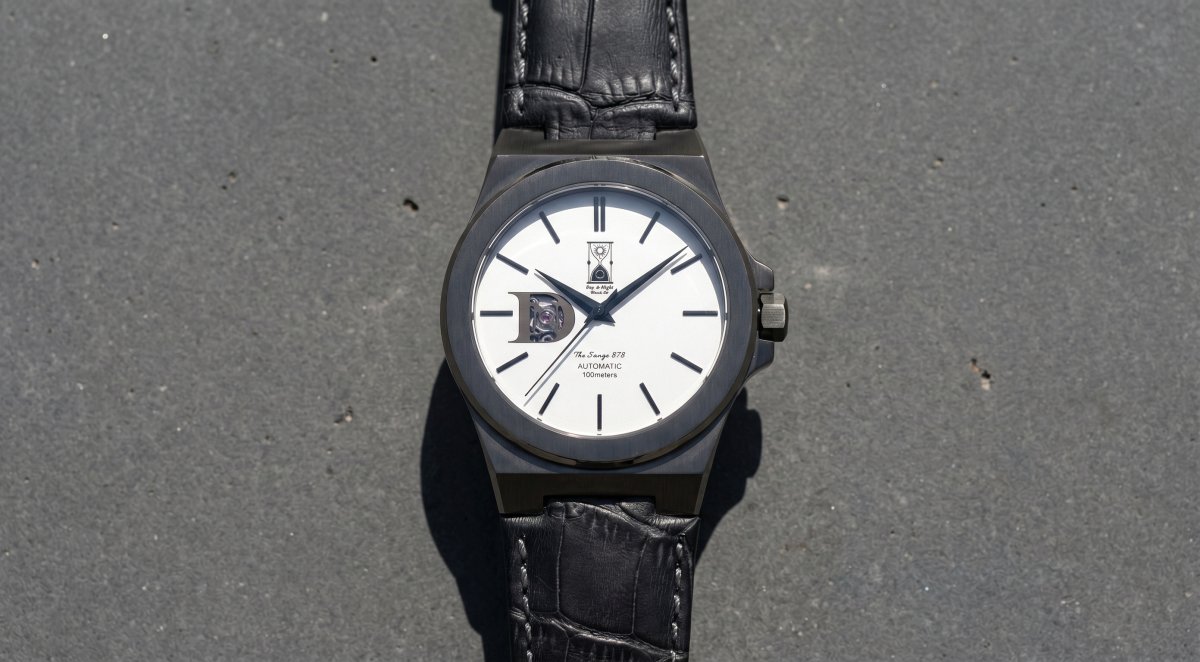
Most automatic movements without certification run between -20 and +40 seconds per day, though quality calibers like the Seiko NH38 typically perform closer to -15/+25. COSC-certified chronometers must stay within -4/+6 seconds per day. If your watch consistently exceeds these ranges, it likely needs regulation or demagnetization. The Sango 878 Collection uses the NH38 movement, which is known for reliable timekeeping within standard automatic tolerances.
How do I measure my automatic watch accuracy at home?
Set your watch to an atomic clock reference, wear it normally for 24 hours, then compare the time. Record the difference in seconds. Repeat this for 7 days across different positions (crown up, crown down, dial up) to identify positional error patterns. A timegrapher app or dedicated timing device gives more precise readings, but the manual method reveals real-world daily rate performance.
Do automatic watches become more accurate after a break-in period?
Yes. New automatic movements typically need 4-8 weeks of regular wear to settle. During this automatic watch break-in period, lubricants distribute evenly across the escapement, jewels, and mainspring, reducing friction. Many owners report accuracy improving by 5-10 seconds per day after the first month. If accuracy does not stabilize after 8 weeks, a watchmaker can regulate the movement.
What factors affect mechanical watch precision the most?
Magnetism is the leading cause of sudden accuracy loss, followed by positional error and temperature changes. A watch left near speakers, phones, or magnetic clasps can gain or lose minutes per day. Amplitude, beat error, and isochronism also play roles. Regular demagnetization and avoiding extreme temperatures keep factors affecting mechanical watch precision under control.
Automatic movement accuracy comes down to understanding the instrument you're wearing: its rate, its habits, and the forces working on it. Day & Night Watch Co. builds watches for people who want that relationship, with automatic calibers in The Sango 878 collection and precision quartz in The Pharaoh Collection, all backed by sapphire crystal, 316L stainless steel, and a two-year warranty. Explore the collection and find the timepiece that earns its place on your wrist.


Leave a comment