


Table of Contents
- Automatic vs Quartz: The Core Differences That Matter
- Accuracy and Timekeeping: Seconds Per Day vs Seconds Per Month
- How Long Do Automatic Watches Last? Longevity and Service Intervals
- Automatic Watch Maintenance Tips for Everyday Owners
- The Aesthetic Difference: Sweeping Second Hand vs Ticking Motion
- Cost of Ownership, Resale Value, and Environmental Impact
- Choosing Your First Automatic: The Sango 878 Collection
- Conclusion: When an Automatic Watch Is Worth It Over Quartz
- Frequently Asked Questions
Last Updated: September 11, 2026
Automatic vs Quartz: The Core Differences That Matter
If you're weighing why choose automatic watches over quartz, the answer comes down to what you value: the hands-on craft of a mechanical movement or the set-and-forget reliability of a battery-powered one. This guide from Day & Night Watch Co. breaks down both so you can decide with confidence.
An automatic watch is a mechanical timepiece wound by the motion of your wrist, storing energy in a mainspring that releases it to drive the gears. A quartz watch runs on a battery that sends current through a quartz crystal, which vibrates at a precise frequency to keep time. Two philosophies, two very different ownership experiences.
How Automatic Movements Work
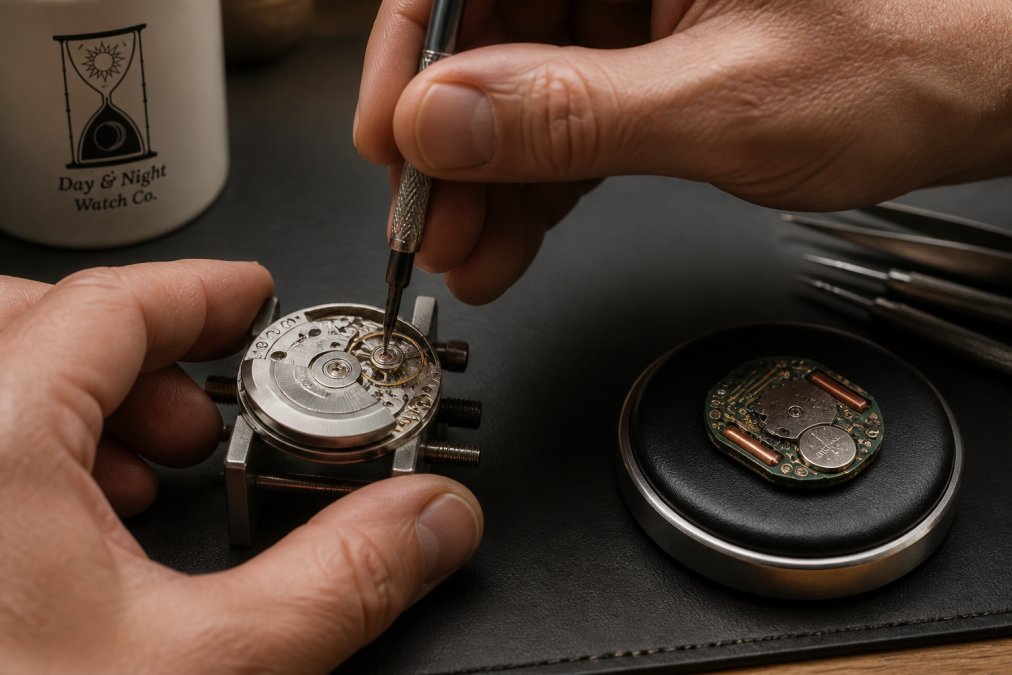
Inside an automatic, a weighted rotor spins as you move, winding the mainspring. That stored energy drives the gear train and balance wheel, the oscillator that regulates timekeeping. Many automatics also support manual winding and a power reserve that keeps them running when you set them down.
How Quartz Movements Work
Quartz movements rely on a battery, a quartz crystal, and an integrated circuit. The crystal vibrates at a steady frequency, and the circuit counts those vibrations to pulse the hands forward once per second. Fewer moving parts means less to service.
Accuracy and Timekeeping: Seconds Per Day vs Seconds Per Month
Quartz wins on raw accuracy, and it isn't close. The reason is the oscillator. A quartz crystal in a watch typically vibrates at 32,768 Hz, that's 32,768 cycles per second, and the integrated circuit divides that frequency down to one pulse per second. An automatic's balance wheel oscillates at a far lower frequency, commonly 21,600 to 28,800 vibrations per hour (that's 6 to 8 beats per second). The higher the frequency, the finer the resolution, and the less each individual error compounds.
In practical terms:
- Quartz: a typical caliber deviates by roughly a few seconds per month, and many are rated to within 15 seconds per month.
- Automatic: a typical caliber deviates by a handful of seconds per day. A well-regulated movement might run within -10 to +20 seconds per day; a chronometer-grade movement is certified to a tighter band.
Do the math and the gap is stark: a few seconds per day becomes a minute or more per month, and several minutes per year. If you set your watch against your phone every morning, you'll notice the automatic drift within a week.
Why the Gap Is Smaller Than It Looks
That daily deviation is not a defect, it's the nature of a mechanical oscillator. What matters is consistency. A well-made automatic that gains four seconds a day, every day, is easier to live with than one that swings unpredictably. Watchmakers regulate a movement by adjusting the balance wheel's effective length or mass, and a good regulation holds its rate across positions and temperatures.
Automatic owners tend to reset the time when they wind or set the date anyway, so the drift never accumulates into a problem. If you need to-the-second accuracy for scheduling, quartz is the safer choice. If you appreciate a living mechanism on your wrist, a few seconds a day is a fair trade.
The Visual Tell: Sweeping vs Ticking
Accuracy isn't the only thing the oscillator frequency changes. Because a quartz movement pulses once per second, its second hand ticks in discrete jumps. An automatic's balance wheel beats several times per second, so the second hand sweeps in a smooth, near-continuous arc. That sweep is the single most visible difference between the two movements on the wrist, and for many buyers, it's the deciding one.
Factor |
Automatic |
Quartz |
|---|---|---|
Oscillator |
Balance wheel, 21,600-28,800 vph |
Quartz crystal, 32,768 Hz |
Typical accuracy |
Seconds per day |
Seconds per month |
Second hand |
Sweeping |
Ticking |
Rate stability |
Sensitive to position, temperature, magnetism |
Highly stable |
Regulation |
Adjustable by a watchmaker |
Not user-adjustable |
How Long Do Automatic Watches Last? Longevity and Service Intervals
A well-made automatic can last decades, and many become heirlooms passed between generations. Longevity depends on the caliber, how you wear it, and whether you keep up with servicing. Expect a service interval of roughly every few years for a mechanical movement.
Quartz watches last a long time too, but their lifespan is tied to battery changes and eventual circuit replacement. The mechanical automatic rewards care with heirloom quality that appreciates with age.
Automatic Watch Maintenance Tips for Everyday Owners
Automatic watch maintenance tips start with consistency. Wear your watch regularly so the rotor keeps the mainspring charged, and store it on a winder during long breaks. Avoid setting the date near midnight, when the mechanism is engaged and vulnerable.
Keep it away from strong magnets, since magnetic fields can throw off timekeeping. Have a professional check the gaskets and seals at service time to protect water resistance, and wipe the case with a soft cloth to preserve the finish.
The Aesthetic Difference: Sweeping Second Hand vs Ticking Motion
The most visible difference is the second hand. An automatic's sweeping second hand glides in a smooth arc, a hallmark of mechanical watchmaking craftsmanship. A quartz watch's ticking motion advances once per second, crisp and precise.
That subtle sweep is why enthusiasts gravitate to mechanical pieces. It signals a movement architecture built from gears, jewels, and a balance wheel rather than a battery and circuit. It's a quiet detail, but it's the one people notice.
Cost of Ownership, Resale Value, and Environmental Impact
Most comparison guides stop at the sticker price. The real picture spans the purchase, the service life, the resale market, and what happens to the watch when you're done with it.
Up-Front Cost
Quartz is cheaper to buy. A battery-powered movement has fewer parts, no rotor, no mainspring, and no balance wheel, so it costs less to manufacture and less to replace. Automatic movements carry more components, more assembly labor, and more finishing, and that shows up in the price.
Service and Maintenance Over Time
This is where the two diverge most.
- Quartz: a battery change every couple of years, typically an inexpensive service. When the movement eventually fails, replacement is often cheaper than repair.
- Automatic: a full service, disassembly, cleaning, lubrication, gasket replacement, and regulation, every few years. A full mechanical service is a skilled-labor job, and the cost reflects that. It's a recurring expense quartz owners never see.
Over a decade, a quartz watch can be the cheaper ownership proposition on paper. But that math assumes you replace the quartz watch when it fails, rather than servicing it.
Resale Value and Investment Potential
This is the angle most guides skip, and it's the one that changes the calculus. Quartz watches generally depreciate and stay depreciated, there's little secondary-market demand for a used battery movement. Automatic watches behave differently. A well-regarded caliber from an established maker can hold a meaningful share of its original price, and certain references appreciate. The drivers are scarcity, brand reputation, movement quality, and condition.
That doesn't mean every automatic is an investment. Most aren't. But an automatic is far more likely to retain value than a quartz equivalent, and that resale floor is part of the true cost of ownership. A watch you can sell for a real fraction of what you paid is cheaper than a watch you can't sell at all.
Environmental Impact of Battery Disposal
Quartz watches run on disposable batteries. Those batteries contain metals and chemicals that shouldn't go into household trash, and they need to be recycled or disposed of through proper channels. Over the life of a quartz watch, that's a recurring waste stream, small per battery, but repeated for years.
An automatic has no battery. Its energy comes from wrist motion and a mainspring, and its environmental footprint is concentrated in manufacturing and servicing rather than in ongoing disposables. That's a genuine point in the automatic's favor for buyers who care about what they throw away.
The honest trade-off: quartz is cheaper to buy and maintain, and automatic is more likely to hold value and avoid battery waste. For buyers thinking in decades rather than seasons, the automatic's cost of ownership often evens out, and sometimes comes out ahead.
Choosing Your First Automatic: The Sango 878 Collection
For most first-time buyers, the smartest entry point is a well-built automatic with a proven movement. The Sango 878 Collection from Day & Night Watch Co. pairs the Seiko NH38 automatic caliber with 316L stainless steel and scratch-resistant sapphire crystal, plus water resistance up to 100 meters.
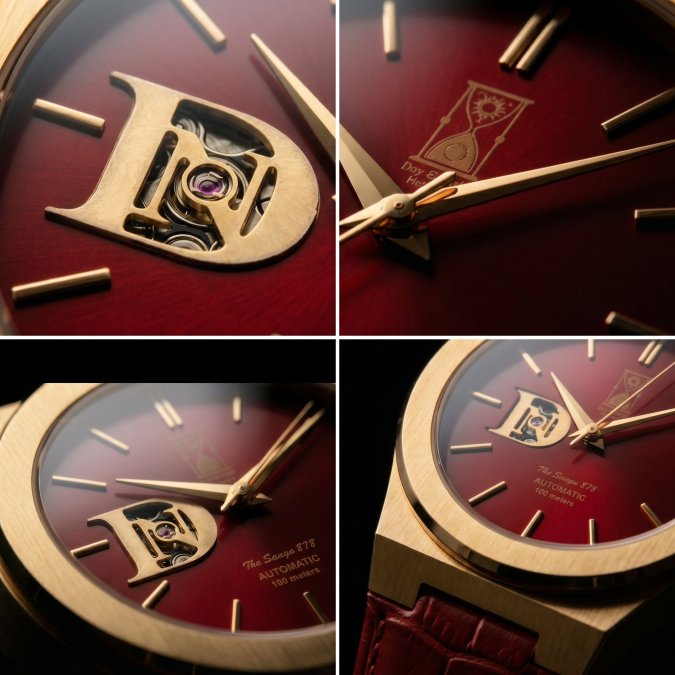
The Sango 878 Crimson Dawn, Gunmetal Eclipse, and Midnight Current each run $369.00 and carry a two-year warranty. If you prefer quartz, the Pharaoh Collection, including The Thutmos3 and The Djoser, delivers the same build quality with battery-powered reliability.
Conclusion: When an Automatic Watch Is Worth It Over Quartz
Choose an automatic when you want a mechanical movement, heirloom quality, and a sweeping second hand that reflects real watchmaking. Choose quartz when accuracy and low maintenance top your list. Both are honest choices; the right one matches your lifestyle.
Frequently Asked Questions
Is an automatic watch worth it over quartz?
It depends on what you value. Automatic watches offer craftsmanship, a sweeping second hand, and heirloom potential that quartz cannot match. They also avoid battery waste. Quartz wins on accuracy and low maintenance. If you appreciate mechanical artistry and plan to keep a watch for decades, an automatic like the Sango 878 is worth the investment. If you just need reliable timekeeping with zero fuss, quartz is the practical choice.
What is the downside of an automatic watch?
Automatic watches are less accurate than quartz, typically losing or gaining a few seconds per day. They require periodic servicing every 3 to 5 years, which costs money and time. They also stop if not worn regularly, so you may need a watch winder. Magnetic fields from phones and laptops can affect timekeeping. Finally, they cost more upfront than comparable quartz models. These trade-offs are the price of owning a mechanical movement.
How does the accuracy of an automatic watch compare to quartz?
Quartz watches are far more accurate, often within 15 seconds per month. Automatic watches typically deviate by a few seconds per day, which adds up to a minute or more per month. The Seiko NH38 movement in the Sango 878 is a reliable automatic caliber, but it still cannot match quartz precision. If split-second accuracy is your priority, quartz wins. If you value mechanical character over perfect timekeeping, automatic is the choice.
Do automatic watches require more maintenance than quartz?
Yes. Automatic watches need servicing every 3 to 5 years to clean and lubricate the movement, costing $100 to $300 or more. Quartz watches mainly need a battery change every 2 to 3 years, which is inexpensive and quick. Automatic watch maintenance tips include avoiding magnetic fields, keeping the watch wound, and storing it properly. Quartz watches are lower maintenance but lack the mechanical soul and long-term repairability of a well-built automatic.


Leave a comment