


Table of Contents
- Tissot vs Seiko Automatic Watches: The Core Differences
- Quick Comparison Table: Tissot vs Seiko Automatics
- Swiss vs Japanese Automatic Movements: A Technical Look
- Design and Build Quality: Sapphire Crystal to Bracelet Clasp
- Price Range and Value: Finding the Best Entry-Level Automatic Watches
- Accuracy, Durability, and Water Resistance Compared
- Automatic Watch Maintenance Tips for Long-Term Ownership
- Which Brand Should You Choose? A Decision Framework
- Frequently Asked Questions
Last Updated: September 7, 2026
Tissot vs Seiko Automatic Watches: The Core Differences
A tissot vs seiko automatic watches comparison comes down to a fundamental philosophical divide: Swiss heritage and formal refinement against Japanese innovation and utilitarian value. Both brands produce exceptional automatic watches, but they serve different priorities. Tissot leans into European elegance and brand prestige, while Seiko focuses on in-house manufacturing efficiency and technical experimentation.
The real question is not which brand is "better," but which movement philosophy, design language, and ownership experience aligns with your personal standards. This guide breaks down the technical, financial, and practical differences so you can choose with confidence.
The market treats these as direct rivals, yet they occupy different territory. Swiss watchmaking carries centuries of tradition, while Japanese horology has redefined what accessible mechanical precision means since the 1960s. Understanding this context matters more than comparing spec sheets alone.
Quick Comparison Table: Tissot vs Seiko Automatics
| Feature | Tissot | Seiko |
|---|---|---|
| Movement Origin | Swiss (ETA/Swiss Made) | Japanese (in-house) |
| Typical Power Reserve | 38-80 hours | 41-72 hours |
| Crystal Standard | Sapphire on most models | Sapphire on many, Hardlex on entry |
| Price Range | $300-$1,500+ | $150-$1,000+ |
| Water Resistance | 50m-300m | 30m-200m |
| Design Character | Formal, dress-oriented | Sporty, tool-focused |
| Best For | Professional settings | Everyday versatility |
The table reveals the core tension. Tissot commands a premium for Swiss provenance and polish. Seiko delivers comparable mechanics at a lower entry point, though you may sacrifice some finishing refinement. Neither is objectively superior; your priorities dictate the winner.
Swiss vs Japanese Automatic Movements: A Technical Look
Most brand comparisons stop at 'Swiss vs. Japanese' as a philosophical divide. This section goes deeper: a head-to-head of the specific caliber families you will actually find inside these watches. Understanding the movement is the single most important factor in predicting long-term ownership satisfaction, as it dictates accuracy, service costs, and daily feel.
The Workhorses: ETA 2824-2 vs. Seiko 4R36
The most common automatic movement in entry-level Tissot models is the ETA 2824-2 (or its Swatch Group sibling, the Powermatic 80). The most common in Seiko's entry and mid-tier lineup is the 4R36 (found in the Seiko 5 Sports and many Prospex models). Comparing these two reveals the core philosophical difference in practice.
- Beat Rate: The ETA 2824-2 beats at 28,800 vph (4 Hz), producing a smooth, sweeping seconds hand. The Seiko 4R36 beats at 21,600 vph (3 Hz), which is visibly less smooth but places less stress on the escapement over time.
- Power Reserve: The ETA 2824-2 offers a standard 38-hour reserve. The Seiko 4R36 offers 41 hours, a slight edge for those who rotate watches and leave one sitting over a weekend.
- Hacking and Hand-Winding: Both movements offer hacking (seconds hand stops when setting time) and hand-winding. This is a critical point: many older or cheaper Japanese movements lacked hand-winding, but the 4R36 includes it, making it a direct functional competitor to the ETA.
- Accuracy: The ETA 2824-2 is officially rated at ±12 seconds per day, though in practice, many run tighter. The Seiko 4R36 is rated at -15 to +25 seconds per day. This is a meaningful difference: a 4R36 could run 25 seconds fast per day, which is noticeable over a week.
The Modern Twist: Powermatic 80 vs. Seiko 6R35
Tissot has largely replaced the ETA 2824-2 with the Powermatic 80, an ETA-derived caliber with an extended 80-hour power reserve. This is achieved by reducing the beat rate to 21,600 vph and using a thinner mainspring. The trade-off is that many Powermatic 80 versions use a plastic (synthetic) escapement lever and escape wheel, which reduces friction but has drawn criticism from purists who question long-term durability. The Seiko 6R35, found in higher-end Prospex models, offers a 70-hour power reserve at 21,600 vph and uses all-metal components throughout.
Design and Build Quality: Sapphire Crystal to Bracelet Clasp
Tissot excels at case finishing and dial texture that evoke entry-level luxury. Their bracelets feature solid links and secure clasps, with polished center links that catch light elegantly. Sapphire crystal appears across most of their automatic lineup, providing genuine scratch resistance for daily wear.
Seiko's design language leans sporty and functional. Their dive watches and field watches use strong stainless steel cases with aggressive brushing that hides wear well. The bracelet clasp on many Seiko models feels utilitarian compared to Tissot's refined push-button deployment, though higher-end Seiko lines close the gap significantly.
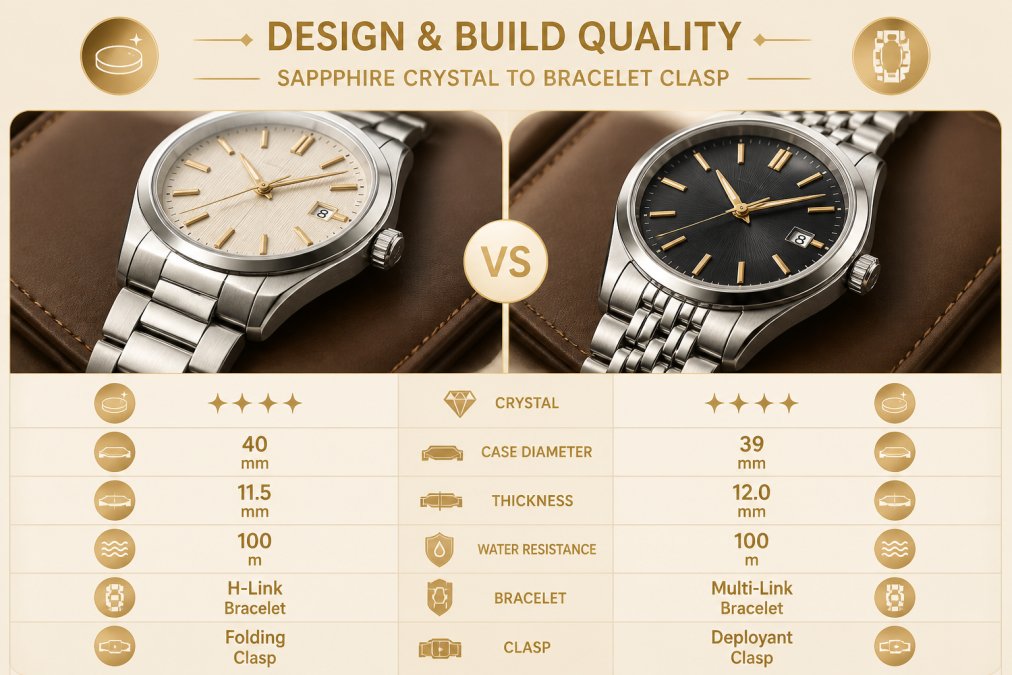
A common mistake is assuming sapphire crystal is universal. Seiko uses Hardlex, their proprietary hardened mineral glass, on budget models. Tissot typically fits sapphire across the board. If scratch resistance is non-negotiable, verify the crystal specification before purchasing either brand.
Do not assume every Seiko automatic includes sapphire crystal. Many entry-level models use Hardlex, which scratches more easily than sapphire. Check the specific model's specifications before buying if scratch resistance matters to you.
Price Range and Value: Finding the Best Entry-Level Automatic Watches
The best entry-level automatic watches from Seiko start around $150, offering incredible mechanical value. Models like the Seiko 5 line deliver automatic movement, hacking, and hand-winding at impulse-buy prices. Tissot's entry point sits higher, typically $300 to $500, reflecting Swiss manufacturing costs and brand positioning.
Paying more for Tissot buys heritage, refined finishing, and Swiss certification. Paying less for Seiko buys technical capability and ruggedness. For professionals seeking a symbol of achievement rather than a pure utility tool, the premium often justifies itself.
Consider the long-term picture. A $369 automatic watch with sapphire crystal and a reliable movement, backed by a two-year warranty, represents strong value. Seiko's lower prices are attractive, but factor in potential upgrades like aftermarket sapphire or better bracelets that narrow the gap.
Accuracy, Durability, and Water Resistance Compared
Both brands produce reliable automatic movements, but accuracy expectations differ. Tissot's ETA calibers often achieve chronometer-like precision with regulation, typically within -5 to +15 seconds daily. Seiko's standard movements run looser, around -15 to +25 seconds daily, though their higher-tier calibers rival Swiss precision.
Water resistance varies dramatically by model rather than brand. Tissot dress watches offer 50m resistance, sufficient for hand-washing but not swimming. Seiko dive watches reach 200m, genuinely capable for recreational diving. For an active professional who transitions from office to outdoor activities, a 100m rating provides real versatility and peace of mind.
Durability favors Seiko in practice. Their movements tolerate shocks and neglect better, and their service intervals stretch longer between maintenance. Tissot movements require more careful handling and more frequent servicing, though they reward owners with smoother operation when properly maintained.
Automatic Watch Maintenance Tips for Long-Term Ownership
Automatic watch maintenance tips center on three practices: regular wear, proper storage, and scheduled servicing. Automatic movements self-wind through wrist motion, so wearing your watch several days per week keeps the mainspring tensioned and lubricants distributed. If you rotate watches, invest in a winder or manually wind monthly to prevent lubricant congealing.
Service intervals matter more than owners realize. Most manufacturers recommend professional servicing every five to seven years, involving disassembly, cleaning, and re-lubrication. Budget $150 to $400 per service depending on movement complexity. Seiko movements often cost less to service due to parts availability, while Swiss calibers demand specialist attention.
Avoid common pitfalls that shorten movement life. Do not adjust the date between 9 PM and 3 AM when the mechanism engages. Keep magnetic sources away from your watch, as magnetization disrupts timekeeping. Store automatic watches away from extreme temperatures and humidity to protect seals and lubricants.
Which Brand Should You Choose? A Decision Framework
Choose Tissot if you prioritize Swiss heritage, refined case finishing, and formal aesthetics for professional environments. Their watches project understated success and pair naturally with suits and business attire. The premium price buys brand recognition and European craftsmanship that resonates in corporate settings.
Choose Seiko if you value technical capability, rugged durability, and mechanical features at accessible prices. Their dive watches and field watches handle active lifestyles without hesitation. For construction workers, outdoor enthusiasts, or anyone whose wrists take a beating, Seiko's strong construction and easier serviceability win.
For those who want heirloom quality without paying Swiss prices, explore [the Sango 878(/products/the-sango-878-crimson-dawn) Crimson Dawn | dayandnightwatches.com] or the Sango 878 Gunmetal Eclipse. These models deliver automatic craftsmanship, scratch-resistant sapphire, and a design built to represent your standards. The Sango 878 Midnight Current offers a bold blue and gold presence for those who want their watch to make a statement.
Frequently Asked Questions
Which automatic watch is better, Seiko or Tissot?
Neither is universally better. Seiko offers exceptional value and in-house movements with strong hacking and hand-winding features at lower prices. Tissot brings Swiss heritage and chronometer-certified options like the Powermatic 80. Your choice depends on whether you prioritize movement innovation per dollar or Swiss craftsmanship and brand history. For a first automatic, Seiko delivers more technical bang for the buck, while Tissot offers a gateway into Swiss horology with a recognized name.
Is Tissot considered a higher-end brand than Seiko?
In the entry-level luxury segment, Tissot often positions itself as a more accessible Swiss brand, while Seiko spans from budget to Grand Seiko luxury. Generally, Tissot carries a higher price tag for comparable specs due to Swiss labor and marketing. Seiko's mass-production scale allows for lower costs. Ultimately, Tissot is not inherently higher-end; it occupies a similar tier to Seiko's mid-range offerings, with brand perception favoring Tissot in Western markets and Seiko holding immense respect among enthusiasts.
How do Tissot and Seiko movements compare in terms of accuracy?
Standard Seiko movements like the NH35 are typically regulated to -20 to +40 seconds per day, though many run better. Tissot's Powermatic 80 movements are often accurate to within +/-15 seconds per day, and some models hold COSC chronometer certification, guaranteeing -4 to +6 seconds. For higher precision, Seiko offers models with their own higher-grade movements. For most users, both are reliable; the difference matters mainly if you demand chronometer-level timekeeping from a stock automatic watch.
What is the best quality automatic watch for the price?
Seiko consistently wins on pure value. Models in the Seiko 5 Sports line, often under $300, offer automatic movements, sapphire crystal on some models, and 100 meters of water resistance. This combination is hard to beat. Tissot's entry-level automatics, like the PRX Powermatic 80, cost more but deliver a superior bracelet and integrated design. The Sango 878 collection from Day & Night Watch Co. also offers a compelling value at $369 with a Seiko NH38 movement and sapphire crystal.
Are Tissot watches more durable than Seiko watches?
Durability depends more on the specific model than the brand. Both use 316L stainless steel cases and many offer sapphire crystal, which resists scratches effectively. Seiko's dive watches, like the Prospex line, are built for serious water resistance and rugged use. Tissot's sportier models are equally robust for daily wear. Serviceability is a key factor: Seiko movements are inexpensive and easy to service anywhere, while Tissot's Powermatic 80 may require specialized parts. Both will last decades with proper automatic watch maintenance.
Choosing between Tissot and Seiko automatic watches ultimately reflects your values. Swiss refinement and Japanese innovation both produce exceptional timepieces, but only one aligns with how you want to show up daily. Day & Night Watch Co. bridges that gap with automatic watches crafted from 316L stainless steel and sapphire crystal, built to endure as a testament to your discipline and legacy. Get started with Day & Night Watch Co. and wear a timepiece that matches your commitment.


Leave a comment